Critical Reading Review
Documentary Modes
• The Poetic Mode ('reassembling fragments of the world', a transformation of historical material into a more abstract, lyrical form, usually associated with 1920s and modernist ideas) (Vérité)
•The Expository Mode ('direct address', “voice of god syndrome” social issues assembled into an argumentative frame, mediated by a voice-of-God narration, associated with 1920s-1930s, and some of the rhetoric and polemic surrounding WW2)
•The Observational Mode (as technology advanced by the 1960s and cameras became smaller and lighter, able to document life in a less intrusive manner, there is less control required over lighting etc, leaving the social actors free to act and the documentarists free to record without interacting with each other) (decisive moment)
•The Participatory Mode (the encounter between film-maker and subject is recorded, as the film-maker actively engages with the situation they are documenting, asking questions of their subjects, sharing experiences with them. Heavily reliant on the honesty of witnesses) (Parr)
•The Reflexive Mode (demonstrates consciousness of the process of reading documentary, and engages actively with the issues of realism and representation, acknowledging the presence of the viewer and the modality judgements they arrive at. Corresponds to critical theory of the 1980s)
•The Performative Mode (acknowledges the emotional and subjective aspects of documentary, and presents ideas as part of a context, having different meanings for different people, often autobiographical in nature) (Herzog)
•Political reflexivity “develops the audience’s awareness of the issue. (Pilger) (Berger) (Moore)
______________________________________________________________________
Documentary Genre
Docufiction Ethnofiction Docudrama Mockumentary Mondo film
| Documentary in Digital Era This article is a two piece essay written by Sharon Lin Tay and Dale Hudson. Tay argues that digital video, editing and composition expose the limitations of visual evidence to trauma, she does an in-depth analysis of the digital aspects into Fallujah (2004) and Christina McPhee’s Conchita Mon Amour as a means to advance discussion of documentary beyond claims to realism; while Hudson’s article goes on to address the controversial subjects of globalization and war. He examines the work done by Eduardo Nava, Mriam Ghani, Zohra Saed, Edward Potter and Qasim Naqvi calling them explicitly poly-vocal unstable and contested.BHARAT PILLAI Aesthetics of Realism The article written by Ohad Landesman discusses the ways in which digital cinematography contributes to the challenging interplay between reality and fiction in the new hybrid documentary form. There is no doubt in the fact that digital technology is gradually changing the ways in which documentaries are shot, edited and exhibited. This article studies the crucial ways in which if the digital format has been aesthetically realized it can challenge critical prophecies and predictions that somehow fail to account for the complicated and inseparable ties it establish with the traditions in its genre. BHARAT PILLAI
|

Freeze Frame A still picture in the course of a movie or television film, made by running a series of identical frames at on desired frame. This was first introduced by Edward Muybridge (1830-1904) who was a photographer who gained his status by photographing the “locomotion” of animals and humans, which are difficult to perceive by the human eye. He used his photography to prove that when a horse is galloping, all four hooves will be off the ground at once. Although Muybridge thought of himself as an artist, he realised that there was a scientific proof in his work, When he published Animal Locomotion, the 781 prints looked scientific and historical and therefore most viewers accepted them as reliable scientific studies of movement. James Hodson | 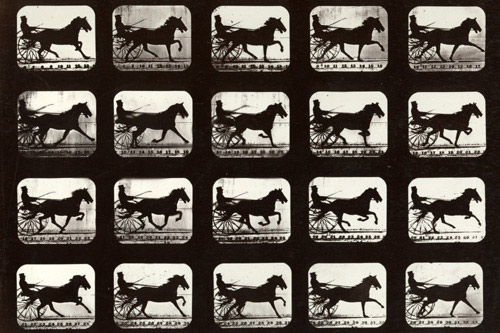 |
Reality Bites: Documentary in the 21st Century
Modern documentaries are now frequently critiqued for being dumbed down, and to have celebrity led narratives. Documentary has changed since the 1930’s since the good old days of John Grierson. In his documentaries he stuck to the belief that what he produced had the emphasis of education and raising awareness, rather than entertainment values, however documentaries from the 1930’s definitely have similarities to modern day documentaries, but more on that later.
Narrowcasting is basically broadcasting that target smaller, more niche audiences. The broadcast itself will not be as popular as the bigger channels like BBC 1, however because the broadcast has the audience in mind, that gives advertising a perfect opportunity to show off their products to the perfect market. For example if a child is watching Nickelodeon, then that particular channel will advertise products suitable for that market such as Action Man toys.
In terms of narrowcasting and audiences, the ‘youth’ market, referred to as the 16-34 demographic. This is the most desirable market, but also the most difficult to catch. Commercially the youth market is seen as the most desirable to advertise because they have a high disposable income and are the earliest adopters of new technology (you are far more likely to have an iPhone than your parents). In terms of PSB (Public Service Broadcasting) channels such as BBC 3, they are not trying to sell products but rather their whole brand to an audience who will one day will be licence fee payers, In an effort to connect with this audience BBC 3 has developed a very distinctive documentary style which they have designed with their young (16-34) demographic in mind.
Blood Sweat and Takeaways is a BBC Three documentary that follows six young Brits to South East Asia to live and work amongst families who work in the food industry. The emphasis is on issues of globalisation, exploitation and the human cost of mass food production.
Borrowing from the hybrid documentary form of reality TV, the participants are clearly selected with contrasting backgrounds and attitudes because, like scripted drama, documentary needs opposing characters, tension and a strong sense of narrative.
Through the series we can see that there is dramatic exchanges between the participants; a lot like Big Brother but in this case it is represented in traditional forms of documentary. One being the voice over used to direct audiences towards a preferred reading. In this case the informal, female voice provides statistics about the hourly wages of the tuna workers and their exploitations.
Throughout the programme, parallels are drawn between the comfortable, affluent lives of the Brits and the lives of the tuna workers.
Clearly this series is aiming to raise awareness of economic exploitation amongst an audience not readily drawn to more ‘traditional’ forms of documentary. Instead Takeaways adopts a more informal approach, for example using a non-diegetic soundtrack featuring artists such as Lady Ga Ga and Elbow and featuring participants who are all under 25 and from a variety of ethnic and economic backgrounds.
Takeaways, like the majority of BBC three’s factual programming, adopts an informal, upbeat mode of
address, despite the fact that it deals with serious and sensitive issues.
Unlike BBC 3, programmes like Bravo and Sky One enlist the help of celebrities to promote their
documentaries. For example Ross Kemp on Gangs, and Danny Dyer’s Deadliest Men. Because the
demographic recognise these people from other films or TV shows which already appeal to them, this
attracts that particular audiences attention and therefore gets more views.
James Hodson
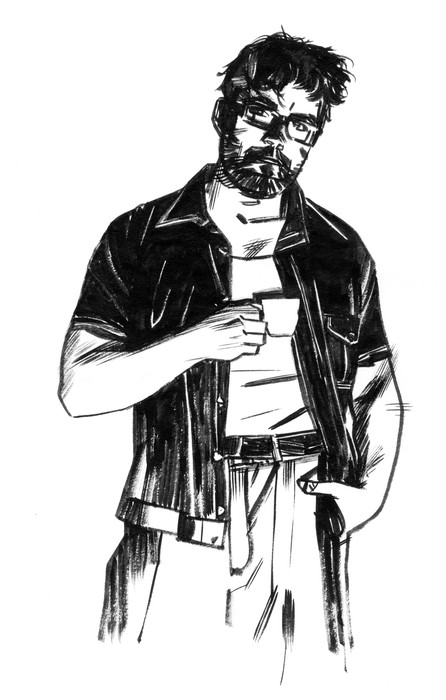 | Transmedia storytelling (also known as transmedia narrative or multiplatform storytelling) is the technique of telling a single story on multiple platforms and formats using current digital technologies. This is used so that the narrative does not only engage the audience but also the different medias used so that the audience feels like they are experiencing the story. The Brandon Generator is a good example of this. Brandon is a struggling writer who gets sucked into an epiphany of coffee and random notes that backtrack him through his life and his writing career. In this case it is a simple platform with four episodes in a comic book like design and by clicking a button the audience can watch all four episodes and see what happens to Brandon. Because this has been produced in a comic book way and the audience has an interaction with this (as they can contribute to the story and click what episode they want to watch) the story is much more appealing to watch than if it was just a half and hour film. I would say that it appeals to a 21st century generation where the interaction with technology is very modern, however I would see the older generation finding transmedia storytelling quite difficult to use, however user friendly it may be. James Hodson |
